
 By times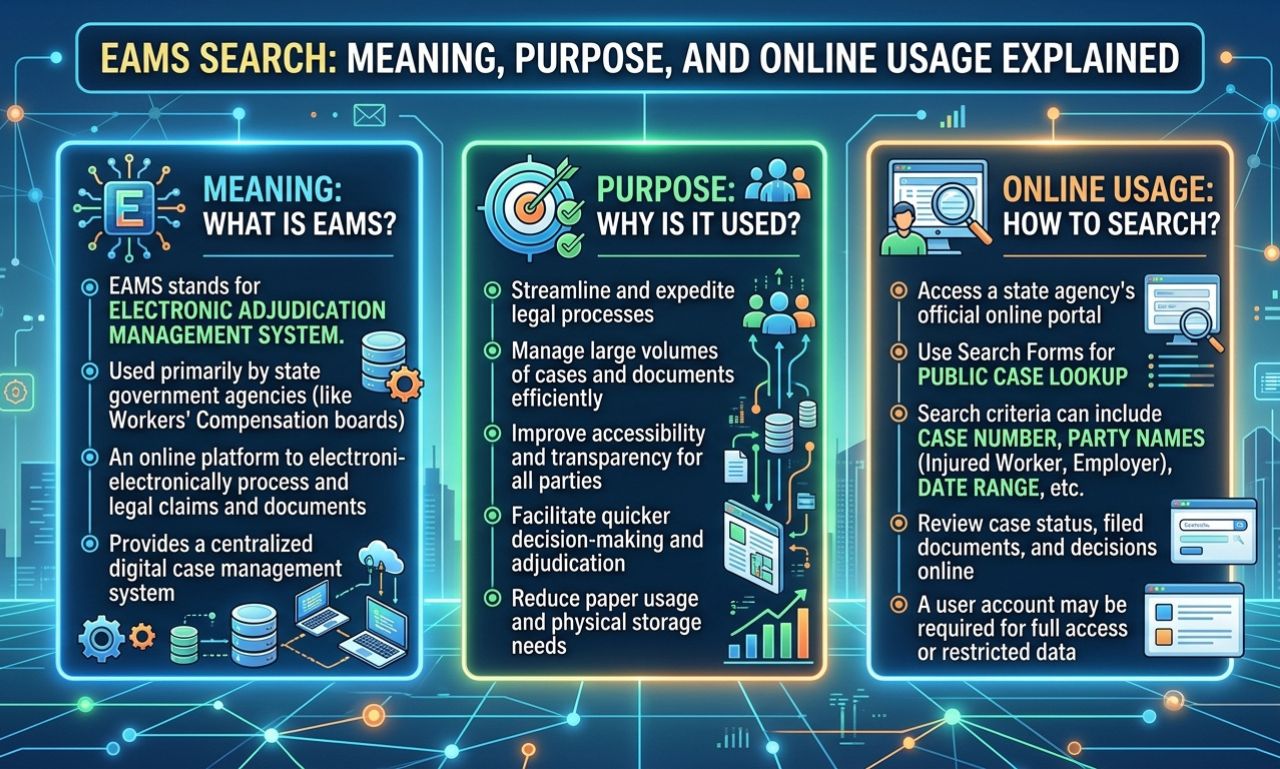
In the digital world, search terms often become important because they help users access specific platforms, systems, or services. One such term that frequently appears online is EAMS Search. Whether users encounter it through legal services, workplace systems, education platforms, or government databases, the phrase has practical importance.
But what exactly does EAMS Search mean? Is it a general search tool, a government platform, or a specialized system? This article explains the meaning, purpose, and common uses of EAMS Search.
What Is EAMS Search?
EAMS Search usually refers to a search function connected to an Electronic Adjudication Management System (EAMS) or another platform using the same acronym.
The exact meaning can vary depending on the organization, but in many cases, EAMS is used for:
- legal case management
- workers’ compensation systems
- education administration
- employee attendance management
- enterprise application management
“Search” refers to the ability to locate records, files, case details, or user information within that system.
Most Common Meaning of EAMS Search
One of the most recognized uses is within workers’ compensation and legal systems.
For example, some government agencies use EAMS to manage:
- case filings
- hearing records
- legal documents
- claim information
- case status updates
Users perform an EAMS Search to quickly find case-related information without manually reviewing large databases.
This improves speed and transparency.
How EAMS Search Works
Although different platforms use different versions, the process is generally similar.
Users may search by:
- case number
- employee ID
- filing number
- party name
- employer information
- claim status
- hearing dates
The system then displays relevant records connected to that query.
Who Uses EAMS Search?
EAMS Search is commonly used by:
Legal Professionals
Lawyers and case managers use it to track legal proceedings and document updates.
Employers and HR Departments
Organizations may use internal EAMS systems for employee management and records.
Government Staff
Administrative departments rely on EAMS for organized digital workflows.
Students and Educational Staff
Some institutions use EAMS-based systems for academic records and attendance management.
Benefits of EAMS Search
The popularity of EA MS Search comes from its efficiency.
Faster Record Access
Instead of manual paperwork, users can retrieve files instantly.
Improved Accuracy
Search systems reduce the risk of missing important records.
Better Transparency
Users can monitor progress and case updates more easily.
Secure Data Management
Centralized systems improve record security and organization.
Why People Search “EAMS Search” Online
Users often search this phrase because they need:
- access to case records
- updates on legal claims
- government filing information
- portal login instructions
- help understanding system functions
Sometimes people are simply trying to find the correct official website for their specific EA MS platform.
Is EAMS Search Different in Every Industry?
Yes. The acronym EA MS can mean different things depending on the organization.
Examples include:
- Electronic Adjudication Management System
- Employee Attendance Management System
- Education Administration Management System
- Enterprise Asset Management Software
Because of this, “EAMS Search” may refer to different tools depending on the context.
SEO and Digital Relevance
From a search engine perspective, EAMS Search is a high-intent keyword because users searching it usually need specific information rather than general reading.
It is relevant for:
- legal websites
- HR software platforms
- government service portals
- education management tools
- enterprise software providers
This makes it an important keyword for professional digital content.
Final Thoughts
EA MS Search is more than just a simple keyword—it represents access to organized digital records across legal, educational, business, and government systems. Whether used for workers’ compensation cases, employee management, or academic administration, it helps users quickly find important information.
As more institutions move toward digital systems, tools like EAMS Search continue to become more valuable. Understanding its purpose can save time, improve accuracy, and simplify complex administrative processes.